
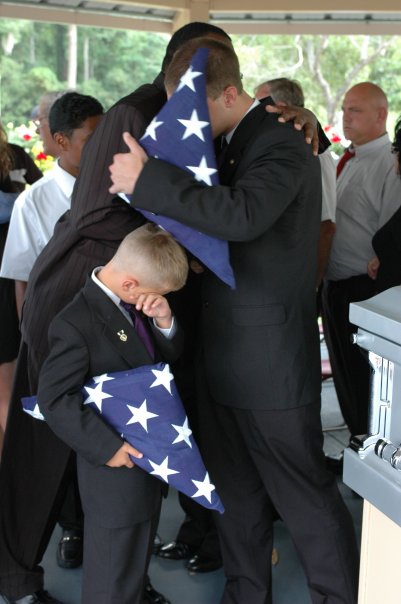
“I’m sorry, ma’am. I have to do it this way,” he said with a kind, firm tone. He was responding to my babble, my unanswerable questions, my erratic spin.
There was another man in uniform next to him, Sgt. Perez. I knew him, yet it didn’t register. There was also a police officer who I went to high school with. The night was dark and quiet. All of this was going on while the boys were asleep inside.
American tradition with its glory and Colors dictated how I would find out. My husband, Roger, of thirteen years had been killed in Iraq. He was driving a Humvee and ran over an Improvised Explosive Device. He was killed instantly, and I know it was fast because they said, “He didn’t know it even happened” like a billion fucking times. My first reaction was to reason with this young man and ask for proof. I thoroughly believed I could argue it away, mechanical and irrational.
I didn’t cry or fall like they do in the movies. There was no yelling because I didn’t want the kids to find out. I stood there in my parents’ front yard on a warm summer night in Southampton, Massachusetts. I’m sure the crickets were making noise, and maybe the bats were circling above, wanting to nuzzle their faces into my tangled hair. I felt like I needed to put on a bra and brush my teeth.
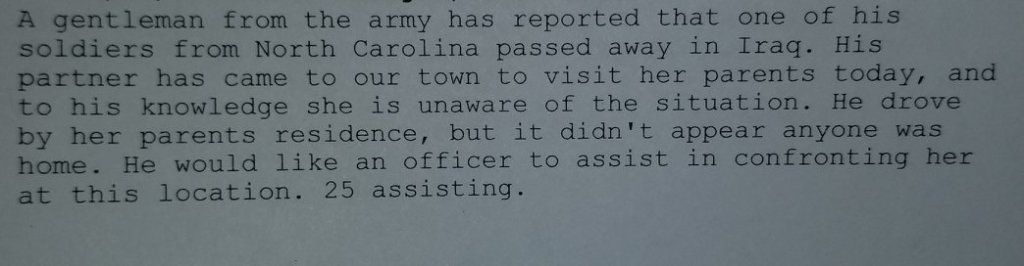
The boys and I had only been in the state for a few short hours. I stood there without my legs, with nobody to hold me. It felt like everything inside me was unattached and floating around. It was all gone. I was floating on very hot nothing, melted hell, and all I could concentrate on was the young private’s face.
“I’m sorry you had to do this,” I said to the poor kid. He just stood there after telling me the words. He looked perplexed, not knowing what to say next, pale. When I recall that night, I still feel for that boy, and the job he had to do, his vital composure.
The stranger and I stared at each other for some time, then for some nonsensical reason, I looked in the window of my parents’ house. There stood Sammy, ten-years old, pillow hair and full lips like his daddy, looking at me through the glass door, wondering who I was talking to in the middle of the night.
 Teresa Forester Adams